Search engines do not read your web pages the way humans do. They look at raw code and try to guess what your business actually does, where you are located, and what you sell.
Schema markup is the code you add to your site to remove that guesswork. It tells Google and other search engines concrete facts about your business in a language they process instantly.
Many small business owners ignore schema markup because it sounds like a technical chore best left for later. That is a mistake, because adding it properly is one of the most reliable ways to make your business stand out in search results without spending more money on advertising.
What schema markup actually is
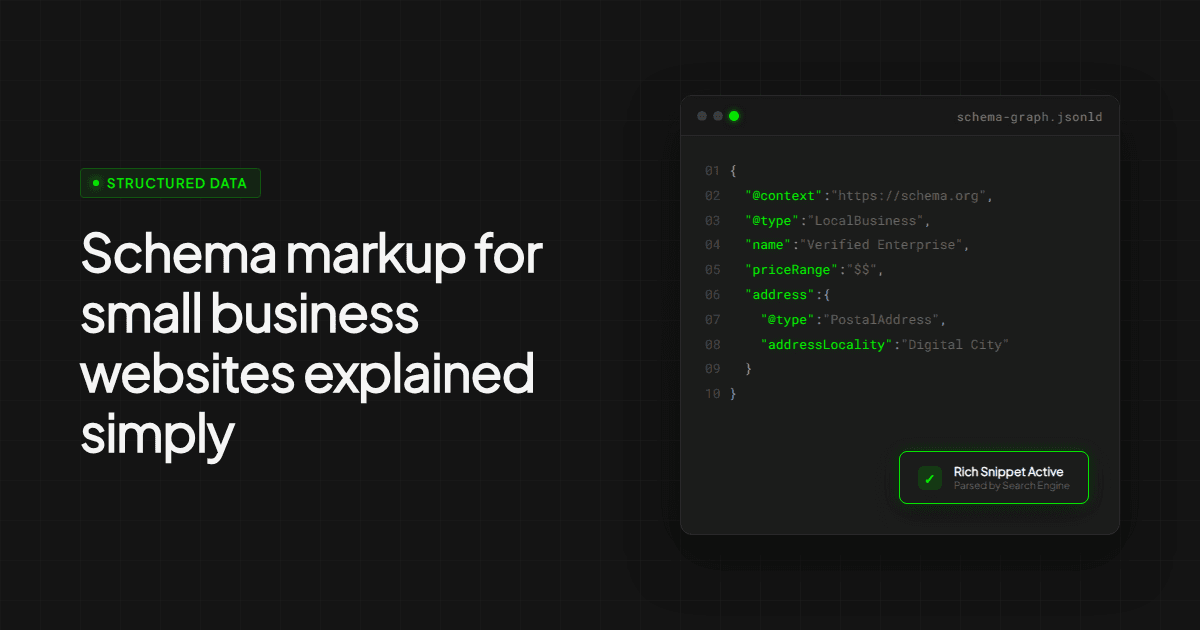
Schema markup is a standardised vocabulary of code that you place on your website. It uses a format called JSON-LD, which sits quietly behind the scenes where visitors never see it.
Think of it as an identity card for your website. Instead of hoping Google understands that the phone number in your footer is your primary customer service line, you label it explicitly as a telephone number. Instead of leaving Google to figure out your opening hours, you state them in a format that machines cannot misinterpret.
This is not a ranking trick or a loophole. It is simply translation. You are translating human readable text into machine readable facts.
Why schema markup for small business websites matters
Large corporations have brand recognition and vast networks of inbound links that help search engines understand who they are. Small businesses rarely have that luxury, especially if they are new or operate in a specific geographic region.
When you implement schema markup for small business websites, you level the playing field for local visibility. You make it much easier for search engines to show your address, star ratings, and service hours directly on the results page.
Google uses this data to populate rich results, which take up more visual space and attract more clicks than standard text snippets. If your competitor has local business schema and you do not, they have a clear advantage before a user even clicks through to a site.
The types of schema that actually help
There are hundreds of schema types available, but most small businesses only need a few. Do not try to implement every possible tag on day one.
Local business schema is the foundation. It declares your legal name, physical address, phone number, operating hours, and geo coordinates.
If you publish articles, guides, or case studies to attract clients, use article schema to tell search engines who wrote the piece and when it was published. If you sell specific products, product schema displays your pricing and stock status directly in search results.
Keep it relevant to what is actually on the page. Adding review schema for reviews that do not exist on the page violates search engine guidelines and can result in manual penalties.
How to implement it without breaking your site
You do not need to edit your website code by hand if you use modern platforms. Most good content management systems and site builders let you inject JSON-LD code safely into the header of your pages.
If you use Webflow or custom builds, you can generate the schema code using free online structured data generators. You paste your business details into the tool, copy the resulting block of code, and paste it into your site settings.
Once the code is live, always test it before moving on. Google provides a free Rich Results Test tool that scans your URL or raw code and tells you immediately if there are syntax errors or missing fields. If the tool reports an error, fix it right away. Broken code is worse than no code at all.
Maintaining your schema over time
Your schema markup is not a set and forget task. Businesses move offices, change phone numbers, and update their operating hours.
If your website says you close at five in the evening, but your schema says six, you create confusion for both search engines and potential customers. Make it a habit to update your structured data every time your core business details change.
Clear data builds trust with search engines, and that trust translates into steady, qualified traffic over the life of your site.
Building something along these lines?
Thirty minutes, no pitch. You describe the problem, I tell you whether it is worth building and roughly what it takes.
Book a call